Oilseed Rape Weevil
Ceutorhynchus spp.Several species of weevils from the genus Ceutorhynchus are important pests of commercially grown oilseed rape (canola) in Europe and North America.
The cabbage seedpod weevil Ceutorhynchus obstrictus, the cabbage stem weevil C. pallidactylus, the rape winter stem weevil C. picitarsis and the rape stem weevil C. napi are the four most important pest species found in Europe.
Adult C. picitarsis infest OSR from mid-September when females perforate the leaf veins, petioles and stems, and lay their eggs under the epidermis from mid-October, whereas females of C. pallidactylus oviposit into petioles in April shortly after females of C. napi oviposit into growing stems in March/April. Females of C. obstrictus begin to lay single eggs inside OSR pods in late spring (Daum et al, 2023).
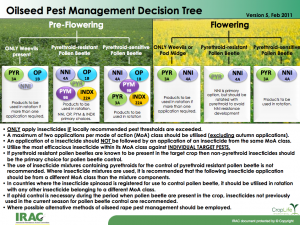
Control of these and other pests of oilseed rape has largely relied on the use of pyrethroid insecticides in Europe. Repeated use of the same insecticide mode of action has inevitably led to some cases of pyrethroid resistance being documented.
Oilseed Rape Weevil resistance profile
The presence of pyrethroid resistant populations of Ceutorhynchus obstrictus in Northern Germany was suspected as early as 2009, but the first confirmation came in 2010. Since this initial discovery resistant populations of this weevil have been identified across several regions of Germany and France. Resistance to pyrethroids has been correlated with the presence of the kdr target site mutation (L1014F). The super-kdr mutation (M918I) has also been found in one population collected from France (Ruck et al, 2024).
Variations in Ceutorhynchus pallidactylus susceptibility to pyrethroids was reported in susceptibility surveys of the species in Germany during 2006., but little evidence of significant shifts in susceptibility have been subsequently reported. Low frequencies of the L1014F kdr target site resistance mutation for pyrethroid resistance have been detected in some individual populations of C.pallidactylus collected in Germany, but this has not yet led to control issues with this species.
Reports of the problems controlling populations of Ceutorhynchus picitarsis with pyrethroids were reported in France during 2013, but resistance was not publicly confirmed until 2016. Pyrethroid resistant populations have since been documented in several regions of central and eastern France and southern Germany. Resistance to pyrethroids has been correlated with the presence of the kdr target site mutation (L1014F), whilst other target site mutations have also been detected at low levels by researchers in France (Ruck et al, 2024).
There have been no substantial reports of resistant populations of Ceutorhynchus napi recorded in Europe, however low frequencies of the L1014F kdr target site resistance mutation for pyrethroid resistance have been detected in some individual populations collected in Germany. This has not yet led to control issues with this species.
The kdr (L1014F) target site mutation for pyrethroid resistance has been documented in several insect species as providing moderate to low levels of resistance (15 to 30-fold). The level of resistance may however be increased in combination with non-target site resistance mechanisms, which can lead to substantially higher resistance factors. Super kdr-mutations such as M918I are documented to have significantly higher impact on pyrethroid susceptibility.
| Species | Distribution | Chemical class | Mechanisms |
|---|---|---|---|
| Ceutorhynchus obstrictus (C.assimilis) | France, Germany | Pyrethroids-Pyrethrins (3A) | Target site mutations: Kdr (L1014F) super-kdr (M918I) |
| Ceutorhynchus napi | France | Pyrethroids-Pyrethrins (3A) | Target site mutation: Kdr (L1014F) |
| Ceutorhynchus pallidactylus | France, Germany | Pyrethroids-Pyrethrins (3A) | Target site mutation: Kdr (L1014F) |
| Ceutorhynchus picitarsis | France, Germany | Pyrethroids-Pyrethrins (3A) | Target site mutations: Kdr (L1014F, L925I, T929N) |